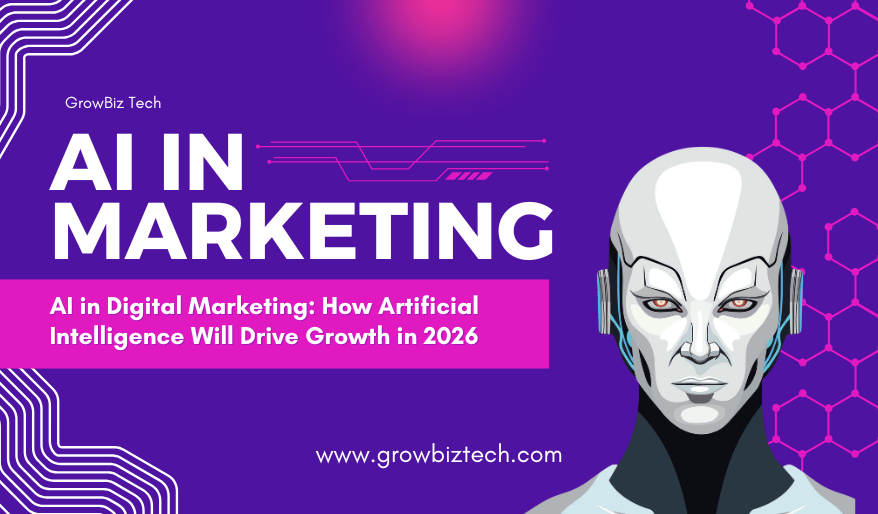
AI in Digital Marketing: How Artificial Intelligence Will Drive Growth in 2026
Small and medium-sized enterprise founders and CEOs are under pressure to grow with limited time, limited headcount, and rising ad costs. At the same time, marketing has become more complex. Search behaviour is shifting, paid platforms change fast, and social algorithms reward speed and relevance.
That is where AI in digital marketing 2026 becomes a real advantage. Artificial intelligence is moving from tools that only save time to systems that improve decision making, automate busywork, and scale what already works. Recent industry surveys show that around 92 percent of companies plan to increase AI investment over the next few years, which signals that AI led marketing will quickly become the standard, not the exception.
What “AI in Digital Marketing” Really Means
AI in digital marketing does not mean replacing your team. It means using machine learning and automation to help your team do three things better: understand customers, create and optimize campaigns faster, and improve performance based on data.
In Simple Terms, Ai Helps You
- Turn data into decisions by finding patterns in leads, sales, and campaign results
- Personalize at scale by matching messages to audience intent and timing
- Automate repeat tasks like reporting, testing variations, scheduling, and optimization
- Predict outcomes by estimating which campaigns or keywords are likely to perform before you spend heavily
Key AI Marketing Trends to Watch in 2026
In 2026, the biggest winners will be companies that connect AI tools to a clear strategy. Tools alone do not create growth. The strategy tells AI what to optimize for and how to measure success.
Trend 1: Search is Becoming Answers First
AI driven search experiences are changing how people discover brands. SMEs must focus on helpful content, clear positioning, and strong technical SEO so their pages can rank and also be referenced in AI generated summaries.
Trend 2: Paid Ads will Rely More on Automation plus Better Inputs
Platforms already use automation, but outcomes depend on your signals. In 2026, brands that feed better audiences, better creatives, and cleaner conversion tracking will outperform those who only turn on automation.
Trend 3: Social Media Will Reward Speed and Creative Testing
AI makes it easier to generate variations of hooks, captions, and creatives. The advantage comes from testing more ideas quickly and doubling down on what works.
Trend 4: Reporting Will Shift from Manual Dashboards to Decision Dashboards
AI can summarize performance and highlight what changed, why it changed, and what to do next. That reduces wasted time and helps CEOs make faster decisions.
AI for SEO in 2026
AI can make SEO faster and more precise, but it must follow quality standards. The goal is not to publish more content. The goal is to publish the right content, improve technical health, and win high intent searches.
How AI Improves SEO
- Keyword clustering to group similar searches into topic clusters so you build stronger content hubs
- Content briefs and outlines based on search intent and competitor gaps
- On page optimization suggestions for titles, headings, internal linking, and FAQs
- Technical SEO checks to identify broken links, slow pages, indexing issues, and schema opportunities
- Content refresh planning to spot pages losing traffic and update them before rankings drop
SEO Tip for CEOs
Use AI to speed up research and drafting, then apply human review for accuracy, brand tone, and real value. Search engines reward helpfulness, clarity, and trust. AI should support that, not replace it.
AI for PPC and Google Ads in 2026
PPC is one of the fastest channels for growth, but it is also one of the easiest places to waste budget. AI helps you reduce waste by improving targeting, bids, creatives, and landing page alignment.
How AI Improves SEO
- Audience building by refining signals based on real converters, not just traffic
- Creative variation testing by generating multiple headlines, descriptions, and image concepts quickly
- Budget allocation by shifting spend toward campaigns hitting CPA or ROAS targets
- Search term control by identifying irrelevant queries and building negative keyword plans faster
- Landing page matching, so ad messaging and page content stay consistent and improve conversion rate
PPC Tips for CEOs
Do not judge PPC success only by clicks. Measure qualified leads, sales, and cost per result. AI can optimize toward the wrong goal if your tracking is incomplete.
AI for Social Media Marketing in 2026
Social platforms move fast. SMEs win when they have a repeatable content system. AI helps you build that system by speeding up ideation, scripting, editing support, and performance learning.
How AI Improves Social Media Marketing
- Content planning that builds monthly calendars around offers, seasons, and audience pain points
- Hook and caption writing with multiple options aligned to your brand voice
- Short form video scripts for reels, shorts, and TikTok style content
- Community management support for replies, FAQs, and DM flows that still feel human
- Performance insights that summarize what topics and formats drive reach, clicks, and leads
sMM Tip For CEOS
Social media is not only for awareness. With the right CTA and landing page, it can become a lead engine. AI makes it easier to publish consistently and test more messages.
A Practical AI Digital Strategy Framework for SMEs
If you are leading a small or mid-size business, you need a plan that is simple enough to execute but strong enough to scale. Use the framework below to integrate AI across SEO, PPC, and SMM without losing control of quality.
Step 1: Define Your Growth Goal and KPIs
Choose one primary outcome for the next 90 days. For example, qualified leads per month, online sales volume, or appointment bookings. Then set supporting KPIs like conversion rate, cost per lead, and lead to customer rate.
Step 2: Build Your Data Foundation
AI needs clean data. Set up accurate conversion tracking, unify website analytics, and ensure your CRM captures lead sources. If data is wrong, AI will optimize the wrong things.
Step 3: Map the Customer Journey
List the stages your buyers go through. Awareness, consideration, decision, and retention. Then assign channels. SEO often supports consideration and decision, PPC drives decision quickly, and SMM supports awareness and retargeting.
Step 4: Create an AI Assisted Content and Creative Workflow
Define how content moves from idea to publish. AI can help at each step, but you still need brand guardrails. Set tone rules, banned claims, and an approval checklist.
Step 5: Launch Test Cycles, not One Big Campaign
Run two to four week sprints. Test one offer, one landing page, and multiple creative variations. Use AI to learn faster and then iterate.
High Impact AI Use Cases for SME Growth
If you want quick wins, start with use cases that reduce cost and increase speed. These often deliver results within weeks, especially for service businesses, local brands, and ecommerce stores.
Use Case 1: AI Powered Lead Qualification
AI can help score leads based on intent signals, form answers, pages visited, and response behaviour. Your sales team can focus on high intent leads first
Use Case 2: AI Content Refresh for Existing Pages
Most SMEs already have content that can perform better. AI can audit your pages, identify missing subtopics, add FAQs, improve structure, and suggest internal links.
Use Case 3: AI Ad Creative Production Pipeline
You can produce multiple ad angles faster, such as different offers, pain points, and calls to action. Then performance data chooses the winners.
Use case 4: AI Assisted Social Content System
Build a library of hooks, scripts, and templates for your niche. This makes content creation repeatable, so you do not start from zero each week.
Common Risks and How to Avoid Them
AI can accelerate growth, but only if it is used responsibly. SME owners should pay attention to quality, privacy, and compliance.
Risk 1: Low Quality or Inaccurate Content
AI can generate content that sounds confident but is incorrect. Always use fact checking and human review, especially for pricing, claims, and policies.
Risk 2: Brand Voice Inconsistency
Without guidelines, AI outputs can sound generic. Set brand tone rules and examples so every piece feels consistent.
Risk 3: Data Privacy and Sensitive Information
Do not upload confidential customer data into tools that you do not control. Use privacy safe workflows and limit what data is shared.
Risk 4: Optimizing for the Wrong Metric
If tracking is weak, AI bidding and optimization can drive cheap clicks instead of real customers. Fix tracking and define success properly.
90 Day AI Marketing Roadmap for SMEs
Use this roadmap to implement AI across your digital strategy without overwhelming your team
Days 1 to 15: Foundation
- Audit analytics and conversion tracking
- Define your 90 day growth goal and KPI
- Document your target customer profiles and offers
- Set brand voice and content guidelines for AI assisted writing
Days 16 to 45: Build and launch
- Create a topic cluster plan for SEO and publish priority pages
- Launch PPC campaigns with clear conversion tracking and strong landing pages
- Build a social media content calendar and start consistent posting
- Set up AI assisted reporting so decisions are faster
Days 46 to 90: Optimize and scale
- Refresh top pages and improve internal linking
- Expand winning ad angles and pause low quality traffic sources
- Add retargeting for social and display
- Create a repeatable workflow so the system runs every month
How GrowBiz Tech Helps You Implement AI Driven Strategy
GrowBiz Tech provides full service digital marketing support, including SEO, PPC Google Ads, social media marketing, content marketing, and web design and development. AI integration works best when your strategy, website, and campaigns are aligned, so this full stack approach helps SMEs move faster without losing quality.
What You Can Expect
- AI ready digital strategy with clear goals, channel plan, KPIs, and execution roadmap
- AI integrated SEO with topic clusters, technical fixes, content planning, and ongoing optimization
- AI improved PPC with smarter audience signals, creative testing, landing page alignment, and budget control
- AI powered SMM with a repeatable content system, fast testing, and performance learning
- CEO friendly reporting with clear insights and next step decisions
Frequently Asked Questions
Is AI replacing marketers in 2026?
AI is replacing repetitive tasks, not strong strategy. The best teams use AI to move faster, test more ideas, and make better decisions.
What is the fastest AI win for an SME?
Most SMEs see fast value from AI assisted PPC creative testing, content refresh of existing pages, and simplified reporting dashboards.
Do I need a big budget to use AI in digital marketing 2026?
No. The key is a clear plan and clean tracking. Many AI improvements come from smarter workflows and better testing, not expensive tools.
How do I keep AI content accurate?
Use human review, fact checking, and a brand checklist. Treat AI as a draft assistant, then publish only what meets quality standards.
Digital Marketing Terms Used in This Blog
If you are not familiar with digital marketing terminologies, then this section will help you in understanding the key terms used throughout the blog in clear and simple language. If you already have a basic understanding of digital marketing terms, you may skip this section and continue reading the main content.
Search Engine Optimization (SEO)
SEO is the process of improving your website so it appears in search engine results when people search for your products or services.
Pay Per Click Advertising (PPC)
PPC is a paid advertising model where you pay when someone clicks on your ad. Common examples include Google Ads.
Social Media Marketing (SMM)
Social media marketing involves using platforms like Facebook, Instagram, LinkedIn, and TikTok to promote your business. AI helps with content ideas, posting schedules, and performance analysis.
AI in Digital Marketing
AI in digital marketing means using artificial intelligence to plan, run, and improve online marketing activities such as SEO, paid ads, and social media. It helps businesses reach the right audience faster and reduce wasted effort.
Digital Strategy
A digital strategy is a clear plan that explains how your business will use online channels to achieve growth goals. It connects SEO, PPC, social media, content, and analytics so they work together instead of separately.
Generative AI
Generative AI creates content such as text, images, or video drafts based on prompts. In marketing, it is used to speed up content creation, ad copy testing, and social media ideas.
Marketing Automation
Marketing automation uses software and AI to handle repetitive tasks such as email follow-ups, ad optimization, and reporting.
Conversion
A conversion is a desired action taken by a visitor, such as submitting a form, making a purchase, or booking an appointment.
Conversion Tracking
Conversion tracking measures which marketing activities lead to real results.
Cost Per Lead (CPL)
Cost per lead shows how much you spend to generate one potential customer.
Return on Ad Spend (ROAS)
ROAS measures how much revenue you earn for every unit of money spent on advertising.
Audience Targeting
Audience targeting means showing your ads or content to people most likely to be interested in your business
Customer Journey
The customer journey describes the steps a person takes before becoming a customer, from first awareness to final purchase.
Stay Ahead of the Curve
AI adoption is accelerating. Industry research frequently cited in 2025 shows that around 92 percent of companies plan to increase AI investments over the next three years, and many businesses say they want to invest in generative AI for marketing. If your competitors are upgrading their marketing systems, staying manual will become expensive.
Stay ahead of the curve. Contact GrowBiz Tech to implement AI driven strategies across SEO, PPC, and social media for your business.